Posts

Showing posts with the label Becoming a Better Duelist

Becoming a Better Duelist 5: Staple Synchros

Image
It took me well over a month to get back to this, and for that I apologize. The site has not gone wanting for updates, but school has kept me from updating as frequently as I would like. I said when I came back I would do Staple Traps, but at the moment I feel more like doing a post on Staple Synchro Monsters. (First thing's first, I'm going to explain some things to absolute newbies to this game. If you know what you're doing, just press Ctrl-F and then type "the list" and hit enter twice to jump you down to it.) Now, what *is* a Synchro Monster? Well, that's an excellent question! In Yu-Gi-Oh, when you have a Tuner and a non-Tuner monster on your side of the field at the same time, you can summon a synchro monster who's level is equal to (not less than or greater than) the combined levels of said Tuner and non-Tuner monster. For instance, let's say you summon the Tuner Monster Junk Synchron onto the field: Cute little fellow, isn't he? Now...

Becoming a Better Duelist: Prequel

Image
Just pointed someone to this that may or may not know how the basic rules of this game. This isn't that hard, and if you've watched the anime you'll be able to discern most of the rules (that's how I learned, and I've never read a rulebook before), but to be certain: To play Yu-Gi-Oh, you need a deck of at least 40 cards, and no more than sixty. Each deck contains monster, spell, and trap cards. It's up to you on the numbers though, and it WILL vary from deck to deck. Some decks are naturally monster heavy, while others can be spell-heavy. Depending on the banlist, a good competitive deck will often be either light or heavy on traps, running anywhere from 8-16. (Sometimes more.) You start each duel with 8000 Life Points. Typically there are three duels in a match. There are three win conditions, or ways in which you can win (or lose) the game. The first is that one player's life points can hit 0 (this is the most common way to win the game, and the m...

Becoming a Better Duelist 4: Staple Spells Part 2

Image
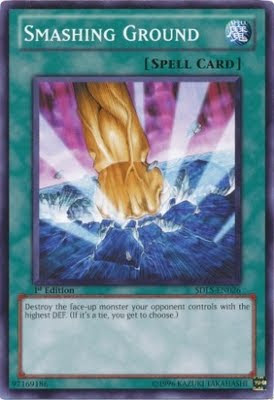
And, I'm back. We're going over the staple spells of this card game. I'll note now as we get into this that due to their versatility and power, many of these staple spell cards are limited to one per deck, something you'll see more and more of as I list them. Let's start! Destroy the face-up monster your opponent controls with the highest DEF. (If it's a tie, you get to choose.) This is a card that's begun to see more play this format (each new banlist creates a new format, as the way people play their decks changes either because they've lost cards or have to react to cards other decks gain access to) because Heavy Storm's existence is forcing people to play fewer traps. With fewer ways to destroy an opponent's monsters, and more boss monsters wandering around this format, people need ways to wipe out cards they can't attack over, and this is an excellent spell for that purpose. The only drawback is that occasionally powerful monsters wi...

Becoming a Better Duelist 3: Staple Spells

Image
This edition is coming a little later than I'd like, and I apologize for that. I'd say blame college, but the truth is my laziness and the time I've spent getting my partying done before school assignments stack up are much more to blame. For this entry, we're going to focus on staple spell cards. The term "staple" is a bit of card game jargon that refers to cards that are so important that there is no true replacement for them, and that they are splash-able--meaning there is no specific requirement your deck must meet in order to use them--so they find their way into every deck. This isn't to say you HAVE to use them, so don't feel boxed in by this, but it does put you at a significant disadvantage if you don't, so be aware of what your chances of winning are when you do not. Anyhow, here we go. Mystical Space Typhoon - Target 1 Spell/Trap Card on the field; destroy that target. One of the oldest, and most versatile spell cards in this game. ...

Becoming a Better Duelist 2: Running Under the Limit

Image
Back with another edition of Becoming a Better Duelist. We've covered the basics of deck construction, and why it's best to stick as close to 40 cards as possible. (It's something that's true in most any card game--the minimum number of cards maximizes the consistency your deck has.) Now, let's delve a little deeper into the concept *of* consistency, and while we're at it, I'll reveal another truth: Your deck doesn't *need* 40 cards. It's true. Most decks can accomplish their win condition with about 25-30 and the rest become cards to shut their opponent's actions down, or worse, "filler" cards that you probably won't need in your average duel. And even if it did need forty cards and smashed at tournaments--eventually, the banlist will hit your deck, limiting the most essential parts to your deck so that it's not so overpowering everyone has to run the same deck to be competitive. So then what? Do you give up on the ...

Becoming a Better Duelist 1: Slimming Your Deck Size

After a brief bit of thinking, I've decided to start doing columns for my friends (most of whom are into Yu-Gi-Oh) about how to improve their game and become a better player. Of course, by no means am I saying I'm the best player ever, or even the best qualified to do this column--but I'm the one with the blog. So, before we get to advanced deck building, card advantage, or budget playing or some of the other things we'll eventually cover, let's start with the basics: Deck Size. Now, when you're done snickering at how that sounds in your head, I'll talk about what that's so important. Done yet? Ok, cool. Now, the first mistake a rookie player makes, is looking at all the cards they *want* to run, and figuring that adding more, is better for you because more cards = more options. This is a fallacy. In a 40 card deck, in which your opening hand is going to be five cards + draw phase, when you draw your opening hand (without your draw phase card), you...